
Choosing among China’s top 10 dehumidifier manufacturers for home use takes more than comparing prices. A unit may look impressive in a catalogue, yet struggle in a cool basement or sound intrusive beside a bedroom. Real rooms are less tidy than product tables suggest.
Building scientist Dr. Joseph Lstiburek’s moisture-control guidance can be paraphrased this way: “Manage moisture early, before it damages the building.” This is a practical lens for evaluating dehumidifiers for the home. Look beyond the headline extraction rate. Check operating conditions, energy use, noise, tank capacity, continuous drainage, and access to replacement filters. A musty closet and a damp laundry room may need different solutions.
This guide introduces ten Chinese manufacturers and the factors buyers can use to assess their products and capabilities. It considers product range, manufacturing experience, quality controls, customization options, and the clarity of technical information. Where available, buyers should verify performance data and request test reports rather than rely on broad marketing claims. Small details matter: a drain hose that kinks, a full-tank alarm that is hard to hear, or a compressor that cycles loudly at night can change daily comfort.
No ranking is perfect. Supplier information can also vary in depth. Use this list as a starting point, then confirm specifications, service support, and suitability for your climate before making a decision.
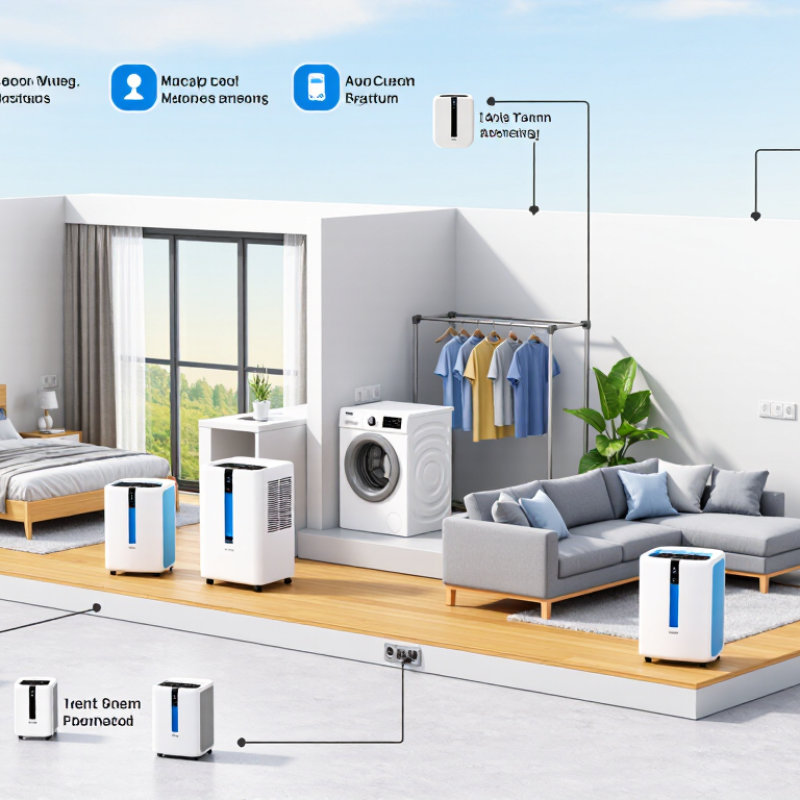
China’s home dehumidifier industry draws on a mature appliance supply chain. Compressor production, heat-exchanger fabrication, plastic molding, and electronic controls are widely established. These capabilities can support varied capacities, from compact bedroom units to larger models for damp basements.
The National Bureau of Statistics of China reported 218.66 million room air conditioners produced in 2023. This is not a dehumidifier production figure, but it indicates the scale of China’s related cooling-appliance manufacturing base.
Grand View Research estimated the global dehumidifier market would grow at a 6.9% compound annual rate from 2024 to 2030. That forecast signals demand, not China’s factory output.
Quality depends on details buyers can inspect: water-removal performance at stated temperature and humidity, noise levels, tank capacity, drainage design, and energy use. A unit that performs well in a warm test room may behave differently in a cool, damp apartment. Not the same. Public data still offers limited visibility into China’s home-dehumidifier output by model or factory, so supplier claims deserve careful verification. That gap matters.
Residential dehumidifier performance depends on more than advertised capacity. For buyers comparing China’s leading home dehumidifier manufacturers, useful features include accurate humidity sensors, adjustable targets, and clear water-tank alerts. The U.S. Environmental Protection Agency recommends keeping indoor relative humidity below 60%, ideally between 30% and 50%. A display showing room humidity can help users adjust settings instead of running a unit blindly.
Most home models use compressor technology, which condenses moisture on a cooled coil. Automatic defrost helps protect performance in cooler rooms, while continuous drainage can avoid repeated tank emptying. Washable filters and accessible coils also make routine maintenance easier. ENERGY STAR reports that certified dehumidifiers use about 15% less energy than conventional models. Still, efficiency depends on room temperature, humidity, and correct sizing.
Specifications deserve a close look. A unit tested under warm, humid conditions may collect less water in a cool basement. That detail is easy to miss. Noise levels, restart memory after power loss, and overflow shutoff can matter in daily use, too. These features are practical, but they do not replace checking the rated capacity and operating conditions against the actual room.
Selecting a home dehumidifier manufacturer in China requires more than comparing catalogue prices. Ask for moisture-removal test results at stated temperature and humidity, not just a headline figure. A unit tested in a warm room may perform differently in a cool basement. Check whether its design suits the spaces your customers use. Small details matter. Confirm tank capacity, hose drainage, auto-defrost behavior, and restart settings after a power cut.
Review how the factory controls production. Request sample inspection records, incoming-part checks, and final run-test procedures. Ask how it tests noise, power draw, sensor accuracy, and leakage. Reliable suppliers should explain tolerances and provide repeatable data, rather than relying on polished brochures. Check the availability of replacement filters, pumps, and control boards, along with realistic lead times. A delayed spare part can turn a minor fault into a customer complaint.
Compare energy use under comparable test conditions, and ask whether published figures are independently verified. Clarify warranty coverage, packaging protection, and technical support before ordering. Factory visits or live video walkthroughs can reveal storage, assembly, and test areas, though one visit cannot confirm every batch will match. No checklist catches everything. I would still test production samples in a real bedroom or laundry room, where doors open and temperatures shift. Manufacturers should welcome specific questions; vague answers deserve a second look.
China’s dehumidifier manufacturers serve homes with different layouts and moisture conditions. These ten profiles highlight common areas of specialization, rather than claiming a verified ranking. One manufacturer may focus on compact units for bedrooms. Another may build higher-capacity models for damp basements. A third may prioritize quiet operation for living spaces. Practical details matter.
Some suppliers emphasize washable filters and simple controls. Others offer continuous drainage, useful in rooms where tanks fill quickly. A sixth profile might center on energy use during long operating hours. A seventh may develop portable units with casters for moving between rooms. An eighth could serve private-label buyers, while a ninth focuses on connected controls. The tenth may provide a broad residential range, from small apartments to larger homes. These are distinct capabilities, not proof that every supplier excels in every area.
When comparing manufacturers, request current product specifications, test conditions, warranty terms, and service arrangements. Check moisture-removal ratings at stated temperature and humidity; figures can shift in cooler rooms. Ask for noise readings and tank capacity, too. Details on paper help, but actual room performance may differ. That gap deserves attention. A credible supplier should explain limitations clearly, not promise effortless results.
This is an anonymized sourcing framework, not a verified ranking or a set of company-specific profiles. The entries describe common product and supplier categories; confirm each supplier’s actual products, certifications, and specifications directly.
| Profile | Typical Product Focus | Technology or Configuration | Potential Home Use | Details to Verify with Supplier |
|---|---|---|---|---|
| 01 — Compact Room Units | Small residential dehumidifiers | Usually compressor-based; portable enclosure | Bedrooms, studies, and small rooms | Test conditions for extraction rate, operating noise, tank size, and restart behavior |
| 02 — Whole-Home Portable Units | Higher-capacity portable models | Compressor system, often with continuous drainage options | Larger living areas or damp utility spaces | Rated capacity and energy use under stated test conditions; hose and pump options |
| 03 — Low-Temperature Models | Units intended for cooler indoor environments | May include defrost controls or a desiccant design, depending on model | Cool basements, garages, and seasonal rooms | Minimum operating temperature, defrost cycle, and performance at low temperatures |
| 04 — Desiccant Specialists | Desiccant dehumidifiers for residential or specialty use | Moisture-adsorbing rotor with a regeneration process | Some cool or temperature-sensitive spaces | Power consumption, heat output, noise, and replacement-part availability |
| 05 — Laundry-Drying Models | Dehumidifiers with laundry-drying or targeted airflow modes | Portable design with selectable fan or operating modes | Indoor clothes-drying areas and laundry rooms | Mode definitions, airflow direction, operating noise, and suitability for the room size |
| 06 — Smart-Control Models | Connected residential dehumidifiers | May provide app control, timers, or humidity settings; features vary by model | Homes where remote monitoring or scheduling is useful | Supported app, network requirements, data handling, and operation without internet access |
| 07 — Quiet-Operation Models | Residential units marketed for quieter operation | Noise-reduction measures may include fan or compressor control | Bedrooms and occupied living spaces | Measured sound level, measurement distance, operating mode, and test method |
| 08 — Continuous-Drainage Models | Units designed for extended operation without frequent tank emptying | Gravity drainage; some models may offer a condensate pump | Basements or other spaces with a suitable drain location | Drain connection, hose compatibility, pump lift where applicable, and overflow protection |
| 09 — OEM/ODM-Oriented Suppliers | Products made to buyer specifications or adapted for private-label programs | Configuration depends on the agreed product specification | Retail programs requiring tailored packaging or features | Factory audit, sample approval, quality controls, minimum order quantity, and production lead time |
| 10 — Export-Focused Suppliers | Residential products prepared for international markets | Electrical and product configurations should match the destination market | Home use in the buyer’s target country or region | Applicable market certifications, voltage and plug, manuals, warranty, and after-sales support |
Dehumidification capacity, energy consumption, and operating performance depend on model and test conditions. Request the product datasheet and independent test documentation before comparing suppliers.
For buyers evaluating Chinese home-dehumidifier manufacturers, quality begins with repeatable performance, not a large advertised capacity. Ask for test results showing water removal at stated temperature and relative humidity; extraction can fall in cooler rooms. A unit tested in a warm chamber may disappoint in a damp basement. Details matter.
Check the compressor, fan, and coils for consistent assembly, and request inspection records from production runs. Test the humidity sensor against a trusted meter, then confirm that the unit switches off near its set point. Ask for sound readings and energy-use data under stated conditions, not just sales estimates. Request reports aligned with electrical-safety and energy-efficiency requirements in your target market. A neat specification sheet can still hide uneven quality, so paperwork alone is not enough.
Purchasing decisions should also account for daily use. Look for a washable filter, a stable water tank, and a drain hose connection that does not leak when gently moved. Confirm replacement-part availability and warranty terms in writing. One point deserves a second look: the highest extraction rate may not suit a small bedroom, where noise and energy use matter more. Compare models in the conditions your customers actually face.
Ask for water-removal results with temperature and humidity clearly stated. Warm-room results may not reflect a cool basement.
Moisture removal can drop in cooler rooms. The difference can be noticeable.
Request records for incoming parts, sample inspections, and final run tests. Ask how the factory checks noise, power use, sensors, and leaks.
Check tank size, hose drainage, auto-defrost, and restart settings after a power cut. Small details count.
Compare readings taken under similar conditions. A quiet bedroom may reveal problems a factory floor misses.
Confirm written warranty terms, packaging protection, technical support, and replacement-part availability. Ask for realistic delivery estimates, too.
It can show storage, assembly, and testing areas. One visit cannot prove every batch will match.
Match capacity to the space, then consider noise and energy use. The highest extraction figure is not always best for a small bedroom. I might still miss something.
This article explores China’s home dehumidifier manufacturing industry, outlining how manufacturers serve households with products designed for different room sizes, humidity levels, and everyday needs. It introduces key technologies and features, including moisture-removal capacity, energy efficiency, noise control, operating modes, drainage options, and safety functions. These factors can help readers understand how dehumidifiers for the home perform and what features may matter most in different living spaces.
The article also presents criteria for evaluating manufacturers, such as production capabilities, product consistency, technical support, and the clarity of product specifications. Profiles of ten leading manufacturers offer a general overview of the range of suppliers in the sector without focusing on brand promotion. The final section discusses quality standards and purchasing considerations, encouraging buyers to compare performance data, suitable operating conditions, maintenance needs, and warranty terms before choosing a unit.
