
Choosing the right desiccant dehumidifier starts with the moisture problem, not the equipment catalogue. A cold storage room, a museum archive, and a production line can all need dry air for very different reasons. Their temperatures, moisture loads, operating hours, and acceptable humidity ranges matter. Get those details wrong, and even a capable unit may struggle.
Psychrometrics expert Donald P. Gatley, an ASHRAE Fellow and author of Understanding Psychrometrics, offers a useful principle: “Understand the air before choosing the machine.” This is a paraphrase of his technical approach, not a verbatim quotation. It points to a practical first step: measure the space under real operating conditions. Record temperature and relative humidity. Note when doors open, when products arrive, and whether the room must stay dry overnight. Small details count.
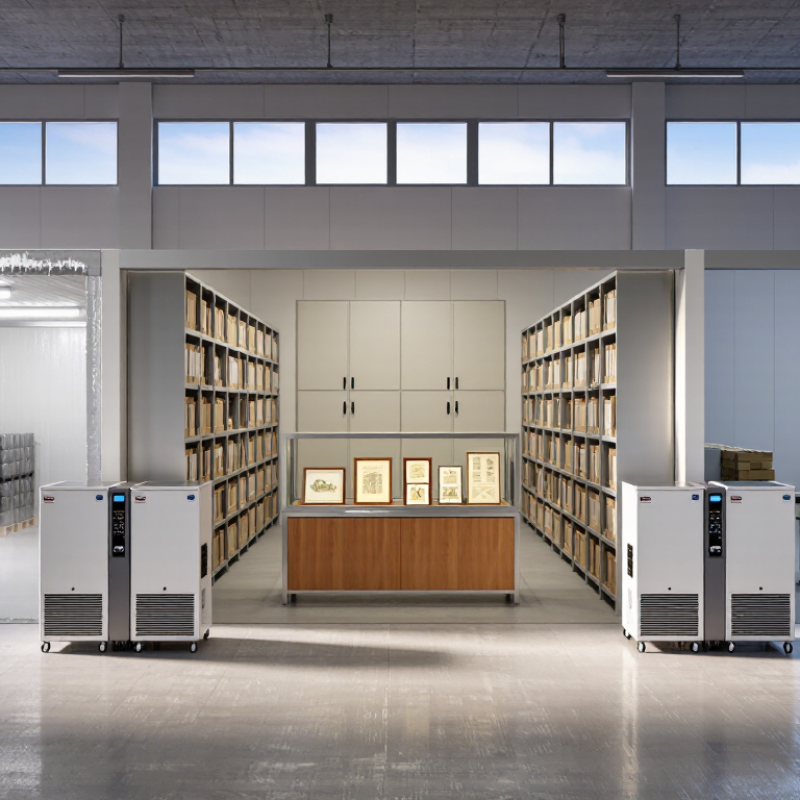
A desiccant dehumidifier uses a moisture-attracting material to remove water vapor, so it can be useful where low humidity or cooler air makes other approaches less suitable. But “more capacity” is not automatically better. Check the required moisture removal rate, regeneration heat source, airflow, controls, and service access. Picture the unit beside a busy loading door: airflow and maintenance access may matter as much as its rated capacity. There is no perfect checklist; site conditions can change, and estimates deserve review. The sections ahead explain how to compare requirements, evaluate system features, and choose a unit that fits the space rather than merely filling it.
A desiccant dehumidifier removes water by adsorption rather than cooling air below its dew point. A rotating honeycomb wheel exposes one section to humid process air. Its desiccant surface captures water molecules, while the dried air leaves warmer than it entered. ASHRAE’s 2021 Handbook—Fundamentals gives a useful reference point: air at 70°F and 50% relative humidity contains about 0.0078 pounds of water per pound of dry air. That moisture ratio, not relative humidity alone, helps describe the load the machine must handle. That is measurable.
As the wheel turns, the moisture-loaded section passes through a separate regeneration airstream. Heat releases the stored water, and the moist exhaust is discharged outdoors. ASHRAE’s 2020 Handbook—HVAC Systems and Equipment describes this continuous adsorption-and-regeneration cycle. The regenerated section then returns to the process-air stream. Heat matters. Because the supply air can leave warm, a system may need downstream cooling, especially in a room with heat-sensitive goods. I would check the regeneration heat source, airflow, and exhaust route before comparing capacity ratings. A slightly open service door or a poorly sealed duct can undermine performance; real installations are less tidy than diagrams.
Before choosing a desiccant dehumidifier, define what “dry enough” means in your space. A storage room holding paper may need different conditions from a production area handling moisture-sensitive materials. Set a target relative humidity range, and note the lowest temperature the room reaches. Desiccant systems can be useful in cool spaces, but the required performance depends on actual conditions.
Measure humidity at several points, not just beside the doorway. A reading near a warm wall may hide damp air in a cold corner. Record temperature and humidity during busy periods, overnight, and after doors open. Small details matter.
Also estimate how much moisture enters through people, wet products, ventilation, or uncovered processes. If these sources change by season, record that too.
A common planning mistake is choosing equipment from room size alone. The moisture load and required drying rate matter just as much. Note whether the space needs steady control or short, intensive drying, and whether clean, dry air must reach specific shelves or machines. Check measurements with a calibrated meter when possible. Early figures are often imperfect; that is a reason to monitor again, not to pretend the estimate is exact. Keep a simple log for a week, including unusual shifts, such as a delivery arriving damp or a loading door staying open.
Match a desiccant dehumidifier to the moisture entering your space, not just its floor area. ASHRAE’s climatic design data provide 0.4%, 1%, and 2% annual-exceedance conditions for HVAC design. The 0.4% condition represents roughly 35 hours in a year. Use your local outdoor dew point alongside indoor humidity targets. Small spaces vary. A workshop with open doors may face a heavier moisture load than a larger, sealed storage room.
Estimate moisture from outdoor air, people, wet materials, and processes such as washdown. Then check the unit’s moisture-removal performance at your actual inlet temperature and humidity. Capacity changes with those conditions, and regeneration settings matter too. A damp pallet or repeated door openings can upset a tidy spreadsheet estimate. Allow for those real operating patterns, but avoid oversizing without evidence: cycling and control behavior may suffer. ASHRAE’s Handbook—Fundamentals is a useful source for local design conditions and load calculations; field measurements can refine the estimate after installation.
How to Choose the Right Desiccant Dehumidifier
Compare Energy Use, Airflow, Controls, and Regeneration Options
Compare total energy use, not just the electrical rating. A desiccant unit may use electricity for its fan and rotor, plus heat to regenerate the desiccant. The IEA’s Global Status Report for Buildings and Construction 2023 estimates that buildings use 30% of global final energy. That makes operating conditions worth checking carefully. Ask for performance at your actual inlet temperature and humidity, not only a headline capacity.
Airflow must match the moisture load and room layout. Check the required dry-air volume, duct pressure, and outlet humidity. A unit can meet its rated capacity yet leave damp corners if air bypasses the target area. Controls matter, too. Dew-point sensors and adjustable regeneration settings can reduce unnecessary operation. Sensor placement is easy to overlook; a reading beside a supply outlet may not represent the whole room.
Compare regeneration options, including electric, steam, and recovered heat, where available. Confirm the required temperature, warm-up time, and exhaust arrangements. Heat recovery may lower purchased energy, but only when its source and schedule match demand. Small detail, big difference. Ask suppliers for a part-load estimate and operating data across seasons. Those figures may still rely on assumptions, so verify them against site measurements after installation.
How to read this chart: At a fixed humidity-ratio reduction of 5 g/kg, each 1,000 m³/h of airflow corresponds to approximately 6 kg/h of moisture removal, assuming air density of 1.2 kg/m³. These values are calculated examples, not product test results. When comparing units, check that airflow and moisture-removal figures match your operating conditions, then compare energy use, control features, and regeneration options at the same duty.
How to Choose the Right Desiccant Dehumidifier
Review Installation, Maintenance, and Operating Requirements
Before selecting a unit, map where it will sit and how air will move through the space. Check doorway width, floor loading, service clearance, and access to power. Duct routing matters, too. A long or restricted duct can reduce airflow and complicate installation. Plan where warm, moist exhaust will go so it does not return to the area being dried.
Maintenance access is easy to overlook. Filters, seals, and moisture-removal components need inspection and cleaning at intervals set by the equipment maker. Make sure staff can reach service panels without moving stored goods or dismantling nearby equipment. Condensate or drainage arrangements may also need checking, depending on the system. Small obstructions can become recurring problems.
Operating conditions should match the application. Compare the required humidity level, airflow, temperature range, and expected hours of use with the unit’s specifications. Desiccant systems can be useful in cooler environments, but performance and energy use still depend on the actual conditions. Include controls and sensors in the plan, and confirm they can measure representative air—not a draft beside a door. One early estimate may be wrong. Recheck it against measured room conditions before final sizing; real spaces rarely behave like a neat drawing.
A rotating honeycomb wheel captures water from process air. A separate heated airstream releases that moisture and carries it outdoors.
The drying process can warm the air. Heat matters. Heat-sensitive goods may need downstream cooling.
Set a target humidity range and note the room’s lowest temperature. Consider whether you need steady control or short, intensive drying.
Measure several spots, including cold corners and areas near stored goods. A doorway reading may miss damp air elsewhere.
People, wet products, ventilation, and uncovered processes can add moisture. Record seasonal changes and unusual events, like a damp delivery.
No. Moisture load, drying rate, airflow, and operating conditions also matter. Early estimates may be imperfect, so check them against room measurements.
Confirm doorway width, floor loading, service clearance, and power access. Plan ducts and exhaust routes carefully; warm, moist exhaust should not return to the drying area.
Check access to filters, seals, and moisture-removal components. Match humidity, airflow, temperature, and operating hours to the unit’s specifications, then recheck sensor readings in representative air.
Choosing the right desiccant dehumidifier starts with understanding how it removes moisture: a moisture-absorbing material captures water vapor, and heat helps regenerate that material so the unit can continue operating. This process can be useful in environments where low humidity must be maintained, including spaces with cool conditions or demanding moisture-control requirements. Before selecting a unit, consider the space’s size, temperature, humidity level, moisture sources, and the target humidity range.
Next, match the dehumidifier’s capacity and airflow to the conditions it will handle, allowing for changing moisture loads and the way air moves through the space. Compare energy consumption, control features, and regeneration options to find a practical balance between performance and operating costs. Finally, account for installation needs, routine maintenance, and operating requirements such as heat or ventilation. A well-matched unit should meet the space’s moisture-control goals while remaining manageable to install, maintain, and run.