
Featured Industrial Precision Dehumidification & Recovery Systems
Configured for continuous industrial duty, ultra-low psychrometric dew points, and dynamic process humidity adjustment with minimal thermal parasitic loads.
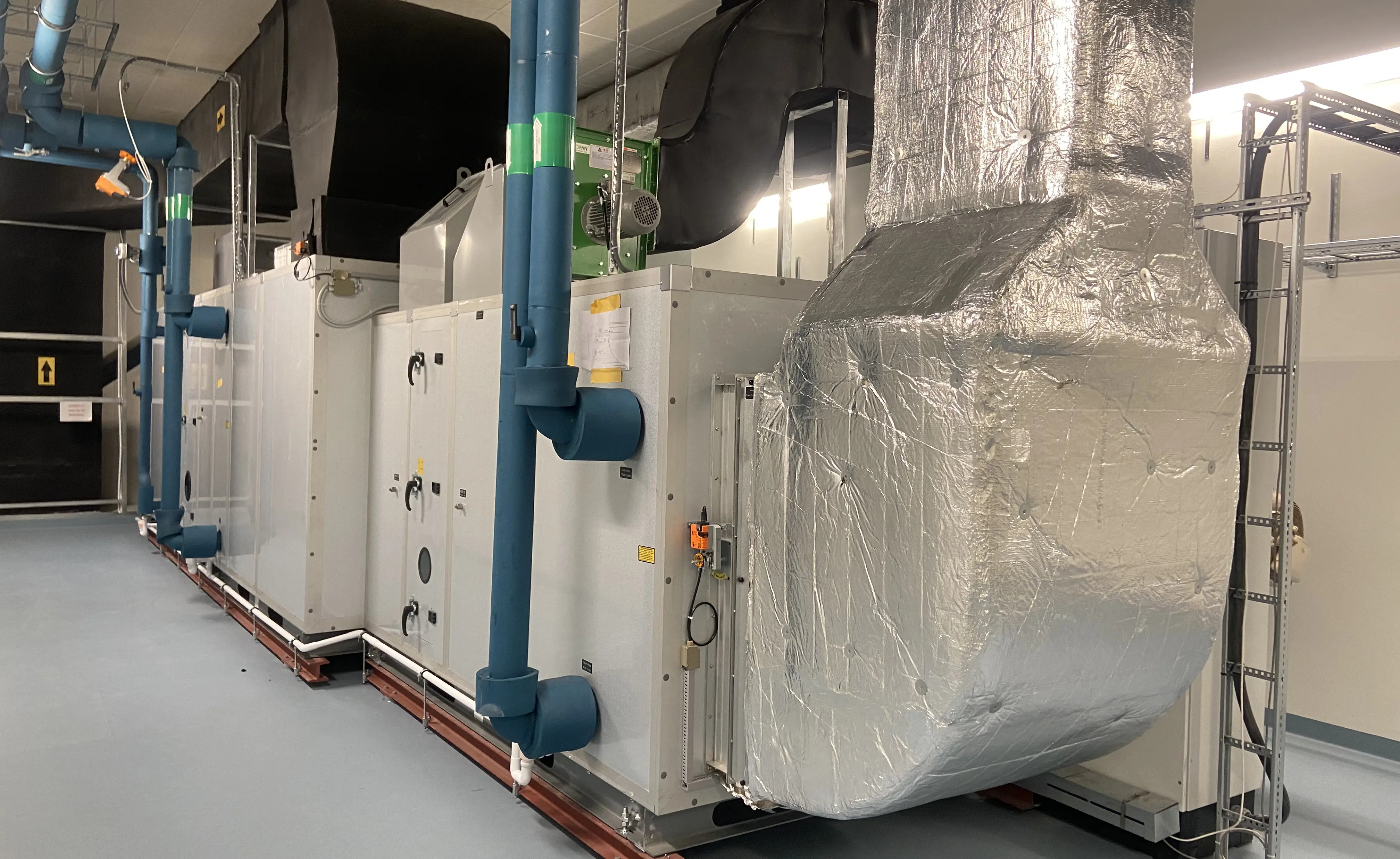 -70°C DP
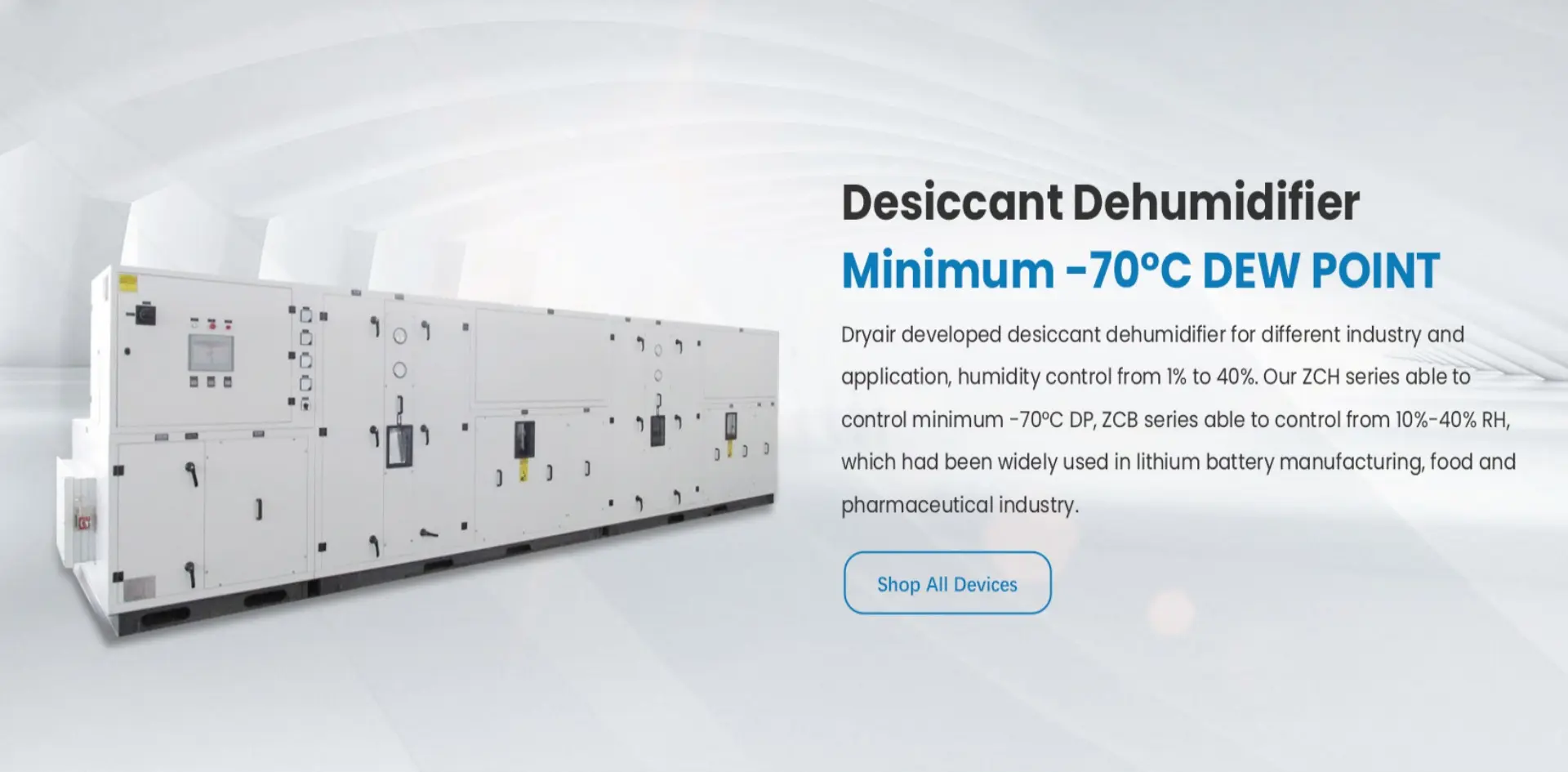
Desiccant Dehumidifier (DHU Series)
Ultra-low dew point dual-rotor desiccant air handler engineered for lithium battery dry rooms and military cleanrooms requiring down to -70°C supply air.
- Minimum -70°C Dew Point Control
- Heat recovery desiccant regeneration
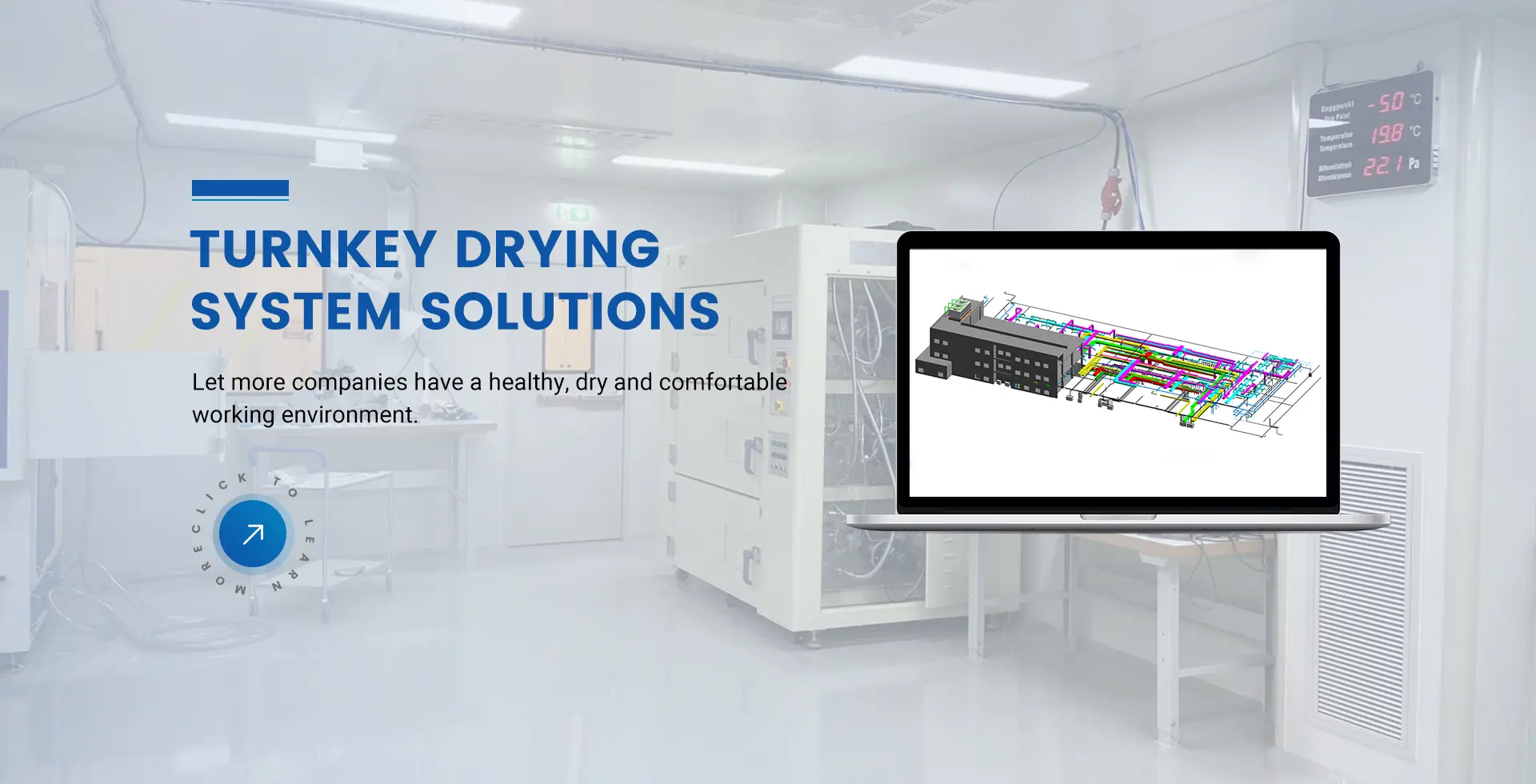
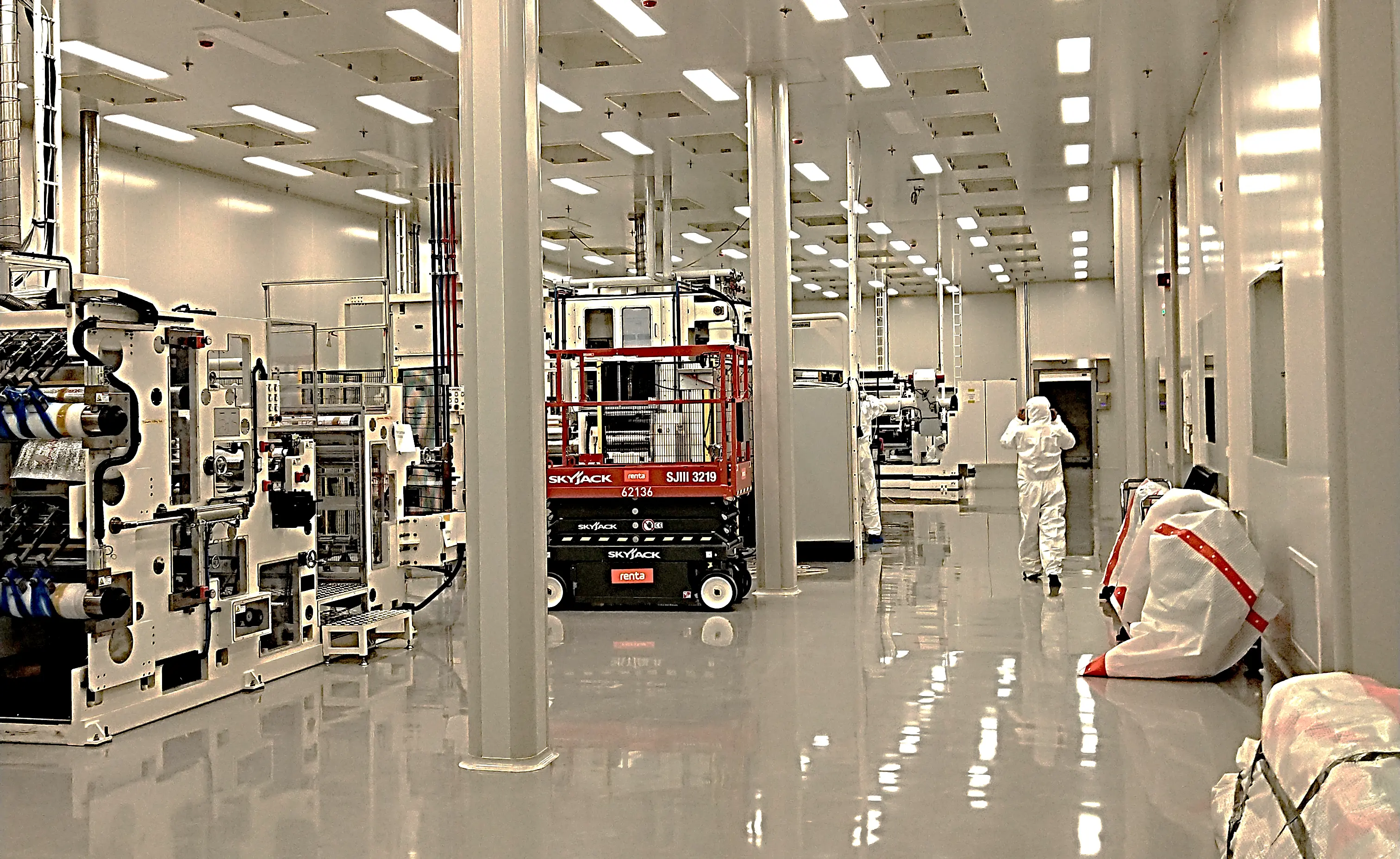 Turnkey EPC
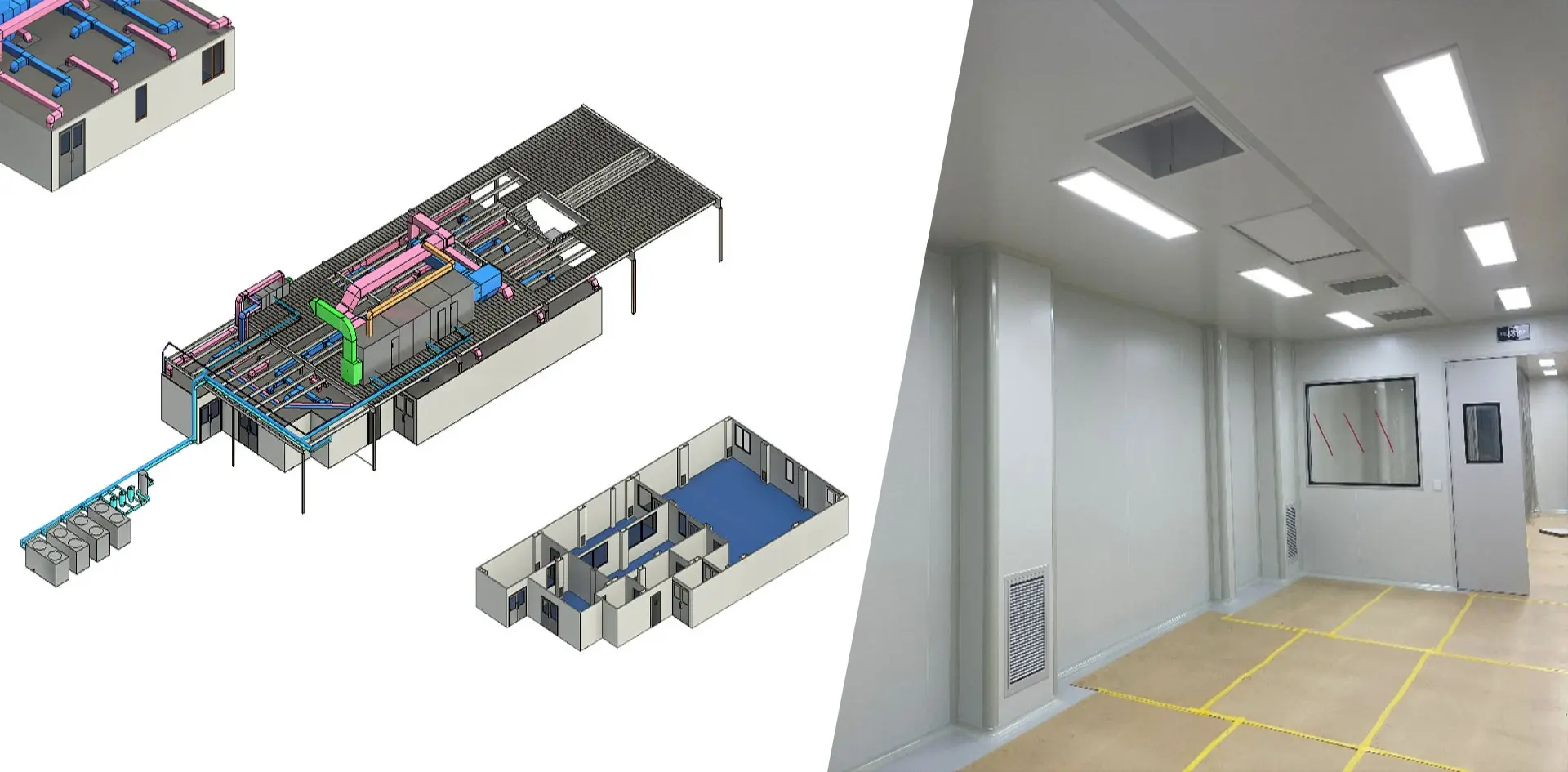
Turn-key Dry Room System
Complete environmental enclosure, hermetic airlocks, low-leakage wall paneling, and intelligent central HVAC controls engineered for gigafactory cell lines.
- Single-contract design & EPC delivery
- Validated with CATL, Tesla, Northvolt
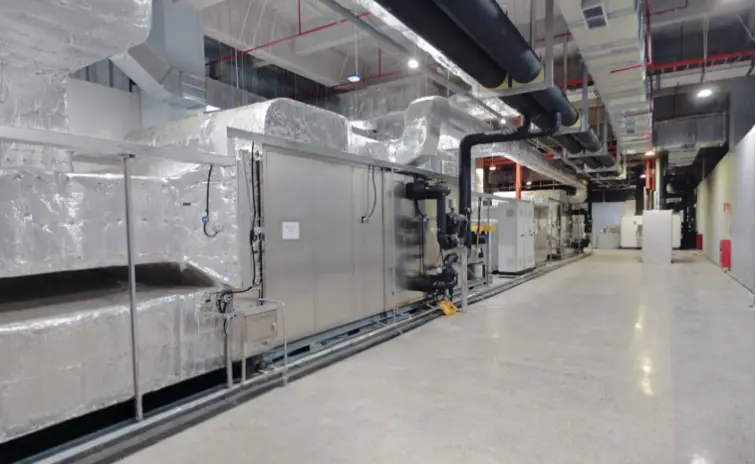 Recovery ≥99%
NMP Recovery System (ZJRH)
Solvent recovery system tailored for battery electrode coater exhaust streams. Recovers N-Methyl-2-pyrrolidone with exceptional purity and minimum thermal waste.
- Solvent recovery efficiency ≥99%
- Direct reduction of factory OPEX
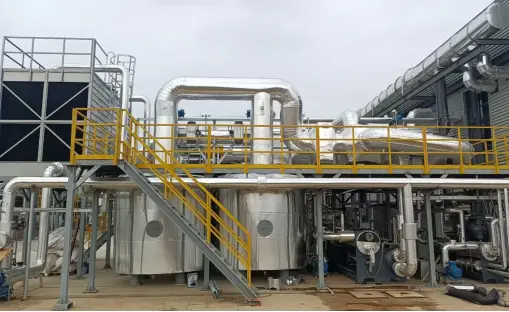 Cooling + RTO
VOC Abatement System (JEN Series)
Integrated deep-cooling condensation combined with regenerative thermal oxidizer (RTO) technology to treat heavy hydrocarbons and organic waste emissions.
- Full environmental emission compliance
- Recovers reusable industrial solvents
 High COP
Industrial Refrigerative Dehumidifier
Energy-optimized mechanical refrigeration dehumidifiers operating as stand-alone warehouse air controllers or pre-cooling stages for rotary desiccant systems.
- High coefficient of performance (COP)
- Variable capacity scroll/screw chillers
 Modular AHU
Low Dew Point Modular Air Handler
Pre-piped, factory-tested skidded desiccant AHU modules built to expedite field installation in international gigafactories with UL and CE electrical listings.
- Plug-and-play modular skid architecture
- Low air leakage class DIN EN 1886 L1
 GMP Compliant
Pharma-Grade Adjustable Dehumidifier
Designed specifically for hygroscopic pharmaceutical powder processing, gelatin capsule drying, and sterile packaging suites under strict cGMP requirements.
- RH adjustable precision within ±1.5%
- AISI 304/316L stainless steel interior
 Zero Emissions
Heavy Industrial Closed-Loop VOC Recovery
Dual-stage chilled condensation combined with zeolite wheel concentration for capturing toxic hydrocarbons, volatile emissions, and chemical vapor streams.
- Closed-loop return air configuration
- Explosion-proof ATEX/IECEx compliance
The Strategic Mandate for Precision Adjustable Humidity Dehumidification
In advanced manufacturing—ranging from gigafactory-scale lithium-ion battery cells and semiconductor lithography to sterile biopharmaceutical compounding—humidity control is no longer a generic comfort HVAC utility. It represents a mission-critical process parameter dictating chemical yield, shelf life, electrochemical stability, and personal operator safety.
Latent Moisture Sensitivity in Electrochemistry
Lithium hexafluorophosphate (LiPF6), the core electrolyte salt in advanced pouch, prismatic, and 4680 cylindrical cells, reacts instantaneously with ambient moisture vapor: LiPF6 + H2O → LiF + POF3 + 2 HF. Trace airborne moisture above -40°C dew point triggers hazardous hydrofluoric acid formation, dissolving the cathode lattice and inducing catastrophic cell degradation.
High OPEX & Parasitic Enthalpy Loads
Rotary desiccant systems represent up to 43% of total electrical and thermal energy consumption in cleanroom operations. Modern procurement directors require Adjustable Humidity Dehumidifiers capable of dynamic modulation—shifting reactivation energy in real time via predictive enthalpy algorithms to eliminate wasteful over-drying during off-peak shifts.
Hermetic Envelope Integration & Leakage
Even the most robust desiccant dehumidifier will fail if building enclosure air infiltration is miscalculated. Industrial engineering requires a single accountable partner who executes the psychrometric calculations, rotor synthesis, continuous airtight wall interlocking, and pressurized airlock balancing under an integrated EPC model.
Engineered Humidity Control Systems Built For Zero Failure Tolerance
Hangzhou DryAir customizes desiccant adsorption curves, thermal wheel regeneration stages, and mechanical pre-cooling circuits based on precise thermodynamic load calculations rather than off-the-shelf standard catalogs.
Lithium-Ion & Solid-State Batteries
For battery cell manufacturing—from cathode/anode slurry drying and separator winding to electrolyte injection and final formation—our DHU desiccant dehumidifiers provide continuous air delivery from -40°C down to -70°C dew point. This protects sensitive active materials (NMC, LFP, NCA, and solid-state sulfide electrolytes) against spontaneous hydrolytic degradation.
Pharmaceutical & Biotechnology
Hygroscopic pharmaceutical active pharmaceutical ingredients (APIs), effervescent formulations, probiotic blending, and soft gelatin encapsulation require continuous relative humidity maintained tightly between 10% and 30% RH at 20°C–22°C. DryAir sanitary air systems feature antimicrobial washdown surfaces, HEPA terminal filtration, and CIP wash cycles.
Aerospace, Defense & Precision Optics
Manufactured under the GJB national military quality standard, our desiccant dehumidification systems safeguard missile guidance electronics, solid rocket propellant storage, radar radar domes, and satellite payload integration cleanrooms against vapor-induced optical clouding, corrosion, and dielectric breakdown.
Engineering Design Targets & Equipment Topology
Specifying the correct moisture removal architecture prevents costly capital over-design and eliminates under-specification risks. Reference our psychrometric selection matrix to configure your upcoming project RFQ.
| Industrial Process & Application Zone | Target Dew Point / RH | Critical Moisture Threat Mechanism | Recommended DryAir System Architecture | Applicable Compliance Standards |
|---|---|---|---|---|
| Battery Electrolyte Filling & Cell Assembly | -40°C to -60°C DP | Hydrofluoric acid generation via LiPF6 decomposition | DHU Double Rotor Desiccant Dehumidifier | CE, UL, CSA, Class 1000 Cleanroom |
| Solid-State / Lithium-Metal Anode R&D | Down to -70°C DP | Passivation layer destruction and spontaneous fire hazard | Cascade Multi-Wheel Desiccant Skid | ISO 14644-1, ASME Pressure Piping |
| Electrode Slurry Coating & Exhaust Drying | ≥99% NMP Recovery | Hazardous N-Methyl-2-pyrrolidone emissions & solvent loss | ZJRH Chilled Condensation + VOC Stripper | ATEX, EPA VOC Standards, EAC |
| Hygroscopic Pharma Tablet Compression | 10% - 25% RH @ 21°C | Powder caking, die wall adhesion, tablet capping | Sanitary DHU Series with Chilled Water Pre-Cool | cGMP, FDA 21 CFR Part 11, ISO 9001 |
| Military Ordinance & Avionics Storage | ≤35% RH (Ambient) | Atmospheric oxidation, propellent ignition instability | Stationary / Skid-Mounted Industrial Desiccant Unit | GJB Military Quality Standard |
| Semiconductor Photolithography Cleanrooms | -20°C to -40°C DP | Resist delamination, optical refraction variances | Chemical Adsorption Desiccant Rotor System | SEMI Standards, ISO Class 1-4 |
| Petrochemical Vapor Recovery & Fuel Depots | Emission <20mg/m³ | Volatile hydrocarbon release during truck/vessel loading | JEN Deep-Cooling Condensation + RTO Unit | ATEX Zone 1/2, NFPA Explosion Proof |
Why Global Gigafactories Choose Hangzhou DryAir
Established in 2010 in Hangzhou, China, Hangzhou DryAir Treatment Co., Ltd. has grown to command over 30% of the domestic high-end desiccant dehumidification sector while operating as an established supplier to Northvolt, Tesla, and TTI.
74 Multidisciplinary HVAC Engineers
Our in-house R&D team features 6 PhD and Master's engineering specialists, 2 National Registered HVAC Engineers, 8 Senior Thermal Engineers, and 58 certified field technicians dedicated exclusively to psychrometric thermodynamic modeling and airflow optimization.
200+ Systems Monthly Capacity
Operating a modernized manufacturing complex in Qingshan Industrial Park, Hangzhou, our CNC sheet fabrication, automated foaming, and rotor assembly bays deliver over 200 heavy industrial dehumidification units per month, supporting multi-phase parallel plant rollouts.
Full Environmental Chamber Testing
Every custom air handling unit and desiccant rotor is tested inside our climate-simulated factory test chamber prior to export packing, verifying supply airflow, differential pressure, motor current, and dew point suppression down to -70°C under load.
Multi-National Export Compliance
Our engineered systems are certified for transatlantic markets, incorporating CE machinery and low-voltage directives, UL 1995/UL 60335-2-40 electrical standards, Canadian CSA listings, ASME code pressure vessels, and Eurasian EAC declarations.
Single-Source Turnkey EPC Delivery
We eliminate contractor fingerprinting. Hangzhou DryAir manages structural cleanroom envelope engineering, hermetic ceiling grids, ductwork insulation, precision refrigeration piping, and PLC cloud integration under one contract with guaranteed dew point metrics.
Optional 2-Year Overseas Service SLA
International clients are supported through remote IoT diagnostic telematics, expedited spare components warehousing, and experienced English-speaking field commissioning engineers available for on-site setup across North America, Europe, and Southeast Asia.
Five-Stage Precision Engineering Process
From thermodynamic envelope modeling to ISO 14644 cleanroom validation, our project methodology guarantees predictable timelines, stable operation, and lowest lifecycle OPEX.
01. Consulting
Dynamic latent moisture load auditing, occupant load modeling, air infiltration assessments, and process dew point criteria definition.
02. Engineering
Psychrometric curve plotting, dual-rotor reactivation sizing, energy recovery integration, and 3D BIM clash detection.
03. Manufacturing
In-house thermal-break casing construction, precision balancing of desiccant wheels, and full load testing in our environmental chamber.
04. Installation
Skid positioning, air-tight ducting assembly, leak testing, chilled water tie-ins, and automated PLC control loop tuning.
05. Validation
Continuous 72-hour dew point data logging, multi-point cleanroom mapping, CE/UL verification, and handover training for local teams.
Frequently Asked Technical Questions by International Engineering Buyers
Everything engineering consultants, EPC contractors, and plant procurement managers need to know about specifying, commissioning, and certifying Hangzhou DryAir systems.
What is the lowest dew point a DryAir desiccant dehumidifier can achieve?
Hangzhou DryAir rotary desiccant dehumidifiers can reliably control process supply air down to a minimum of -70°C dew point (DP). This ultra-low humidity level is critical for lithium battery cell assembly, dry room production lines, next-generation lithium-metal anodes, and hygroscopic chemical compounding.
Do you supply complete turnkey dry rooms for battery factories outside China?
Yes. DryAir delivers complete turnkey dry room projects covering pre-sales consulting, thermodynamic load sizing, air handling unit manufacturing, cleanroom wall/ceiling panel installation, commissioning, and dew point certification. We have delivered successful projects for global clients including Tesla, Northvolt, and TTI.
Which certifications do DryAir systems hold for international export markets?
Depending on client requirements and regional codes, DryAir systems can be configured and certified to CE (Machinery and Low Voltage Directives), UL 1995/UL 60335-2-40 (USA), CSA (Canada), ASME Boiler and Pressure Vessel Code, and EAC (Eurasian Customs Union). Our factory operates under ISO 9001 and the GJB national military standard quality management system.
What solvent recovery rate can a DryAir NMP recovery system reach?
DryAir ZJRH Series NMP recovery systems achieve a verified solvent recovery rate ≥99% on lithium-ion battery electrode coating and drying lines. This system purifies exhausted N-Methyl-2-pyrrolidone vapors for direct operational reuse, slashing solvent replenishment costs and keeping plant VOC emissions strictly within international EPA and European targets.
What after-sales and warranty support is available for overseas buyers?
International buyers receive continuous remote telemetry diagnostics, rapid spare parts shipping, and dedicated on-site commissioning by DryAir engineers. Furthermore, customers can elect to include our optional 2-year full-coverage overseas service agreement covering routine maintenance audits, rotor regeneration checks, and priority technical response.
What makes DryAir an "Adjustable Humidity" dehumidifier manufacturer?
Unlike fixed-speed commercial units, DryAir systems incorporate variable-speed rotor drives (VFD), modulating reactivation gas or electric heaters, and variable face-and-bypass dampers controlled via intelligent PLC algorithms. Operators can dynamically adjust the target relative humidity (from 1% to 60% RH) or dew point (-10°C to -70°C) with precision within ±1% RH.
How does DryAir reduce the energy consumption of desiccant regeneration?
We incorporate multiple patent-pending heat recovery technologies: (1) Purge-sector energy recycling where residual heat from the reactivation zone pre-heats incoming process air, (2) Waste heat integration utilizing client steam, thermal oil, or chiller condenser hot water, and (3) Heat pipe heat exchangers reducing net thermal energy consumption by 25% to 38% compared to legacy rotors.
What is the typical lead time for a complete turnkey dry room or custom AHU?
Standard skidded DHU desiccant dehumidifiers ship within 8 to 12 weeks from finalized engineering drawings. Full turnkey dry room packages (including cleanroom enclosures, air handling units, and integrated refrigeration systems) typically require 14 to 18 weeks for fabrication, factory testing, and dispatch, supporting rapid greenfield gigafactory schedules.
Can DryAir desiccant systems be integrated with building automation systems (BAS)?
Yes. Every DryAir control panel utilizes premium industrial PLCs (Siemens S7-1500 / Allen-Bradley ControlLogix) with native BACnet/IP, Modbus TCP, and Profinet communication protocols. Real-time temperature, dew point, airflow velocity, filter pressure drop, and energy metrics can be streamed directly to facility SCADA systems.
What is the lifespan and service schedule of a DryAir desiccant rotor?
DryAir synthesized silica gel and molecular sieve composite rotors are chemically bonded to an inorganic corrugated honeycomb substrate. With scheduled air pre-filter replacements (G4/F7/H13), the desiccant rotor operates with consistent moisture adsorption capacity for 10 to 15 years in continuous industrial operation.
Explore Complete Dehumidification & Recovery Systems
Select from our field-tested lineup of rotary desiccant units, turnkey cleanrooms, NMP solvent recovery systems, and emission abatement units.
Ultra-Dry Air
Rotary Desiccant Dehumidifier
DHU industrial rotary desiccant systems engineered to reach ultra-low dew points where conventional mechanical chillers freeze up.
- Controllable down to -70°C DP
- Rugged galvanized casing
Full EPC
Turnkey Battery Dry Room
Integrated dry room design, cleanroom insulated envelope, interlocking airlocks, low-leakage ductwork, and 24/7 commissioning.
- Air leakage rate <0.5% vol/hr
- Validated on tier-one gigafactories
Purity ≥99%
NMP Solvent Recovery System
Capture and purify valuable NMP from electrode drying ovens, cutting raw chemical expenditure and meeting zero-emission targets.
- Recovers ≥99% of evaporated NMP
- Integrated distillation columns
Thermal RTO
Industrial VOC Abatement System
Combines deep refrigeration condensation with regenerative thermal oxidation to neutralize chemical process vapors and oil gases.
- Thermal destruction efficiency >99%
- Self-sustaining thermal design
High Efficiency
Refrigerative Dehumidifier
High-efficiency mechanical compression dehumidifier designed for warehouse air drying, food processing, and initial-stage air cooling.
- Eco-friendly R410A/R134a refrigerant
- Precision digital electronic control
 GJB Mil-Spec
Military & Defense Humidity Systems
Reinforced corrosion-resistant environmental control systems engineered to protect ordnance, radar installations, and aerospace equipment.
- Tested under extreme ambient climates
- GJB National Defense certified
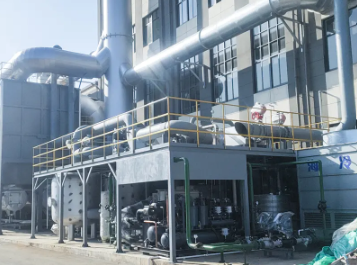 Vapor Recovery
Oil Gas Condensation System
Specialized deep-refrigeration units for fuel loading gantries and chemical storage facilities to capture volatile organic vapors before atmospheric escape.
- Multi-stage cascading chillers
- Low maintenance screw compressors
 Precision Spec
Electronics & Optical Cleanroom AHU
Engineered for semiconductor wafer fabrication, microelectronics assembly, and optical lens coating where moisture leads to micro-corrosion.
- Integrated laminar flow HEPA fans
- Strict temperature ±0.2°C precision
Consult Hangzhou DryAir Engineering Team
Whether you are designing a 50 GWh lithium-ion battery gigafactory, planning a sterile GMP pharmaceutical processing cleanroom, or retrofitting solvent recovery systems, our registered engineers will deliver psychrometric calculations and customized equipment drawings within 24 hours.