
 DP -70°C Control
DHU Desiccant Dehumidifier
High-capacity rotary desiccant dehumidifier featuring synthesized honeycomb silica-gel runner for extreme dry processes.
View SpecificationsEngineered for mission-critical industrial climates where excessive moisture, particulate contamination, and solvent vapor create catastrophic production yields.
DP -70°C Control
High-capacity rotary desiccant dehumidifier featuring synthesized honeycomb silica-gel runner for extreme dry processes.
View Specifications Turnkey EPC
End-to-end dry room integration spanning modular wall cladding, ultra-airtight ductwork, AHU systems, and automated psychrometric PLC logic.
Explore Turnkey Rooms ≥99% Purity Recovery
Specialized condensation and adsorption closed-loop recovery for lithium-ion cathode coating lines, cutting solvent lifecycle overhead.
Inspect Recovery Plant Deep Cooling + RTO
Integrated multi-stage cryogenic condensation and regenerative thermal oxidation to decompose fugitive chemical exhaust.
Review VOC Systems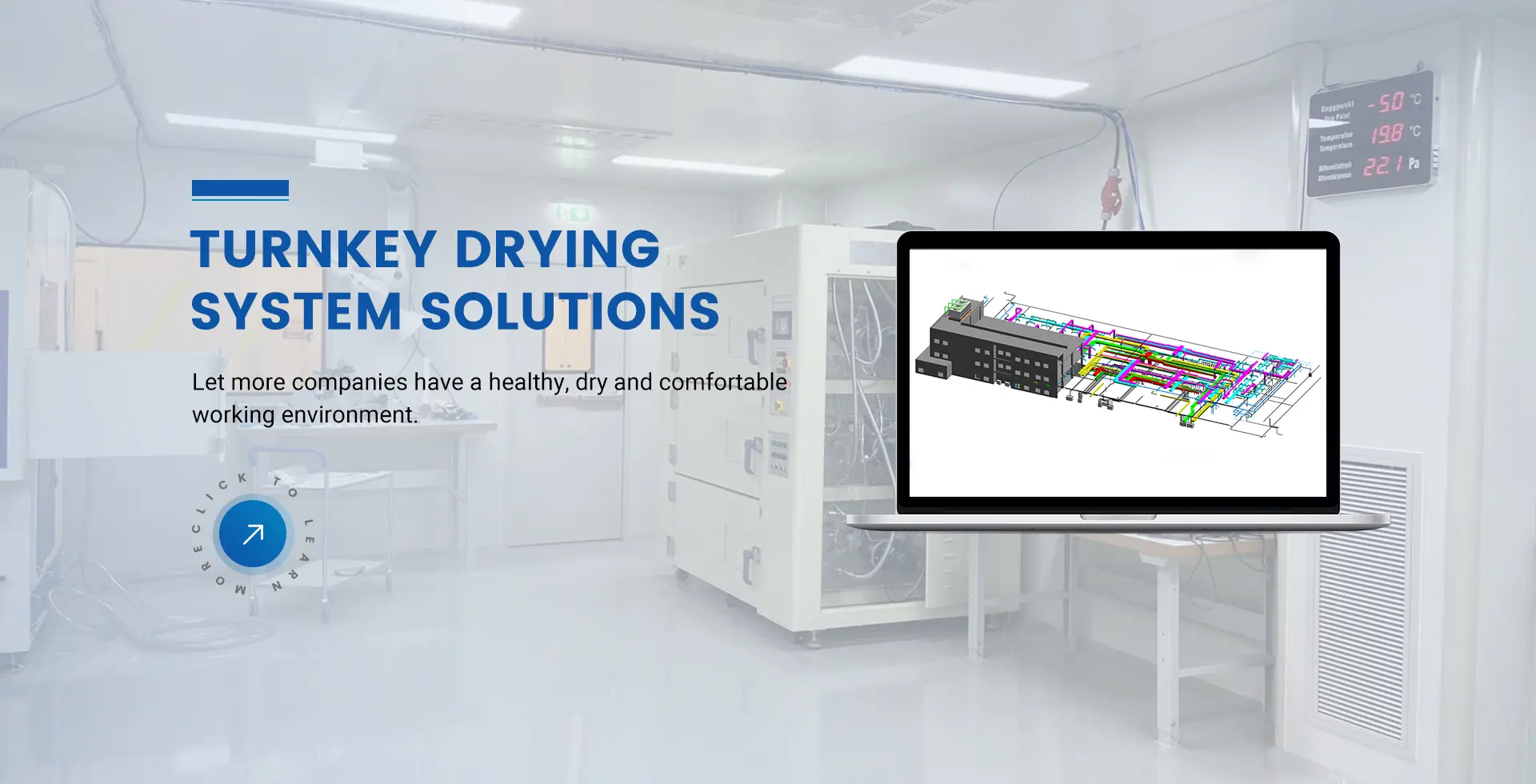 High COP Cooling
High-efficiency mechanical condensation dehumidification tailored for pre-cooling fresh air intake, clean logistics, and storage warehouses.
Discover Chillers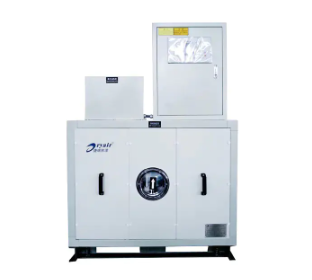 GMP ISO Class 5
Sanitary air handling with HEPA terminal purification, antimicrobial casing, and psychrometric RH holding within ±1% accuracy.
Pharma Specifications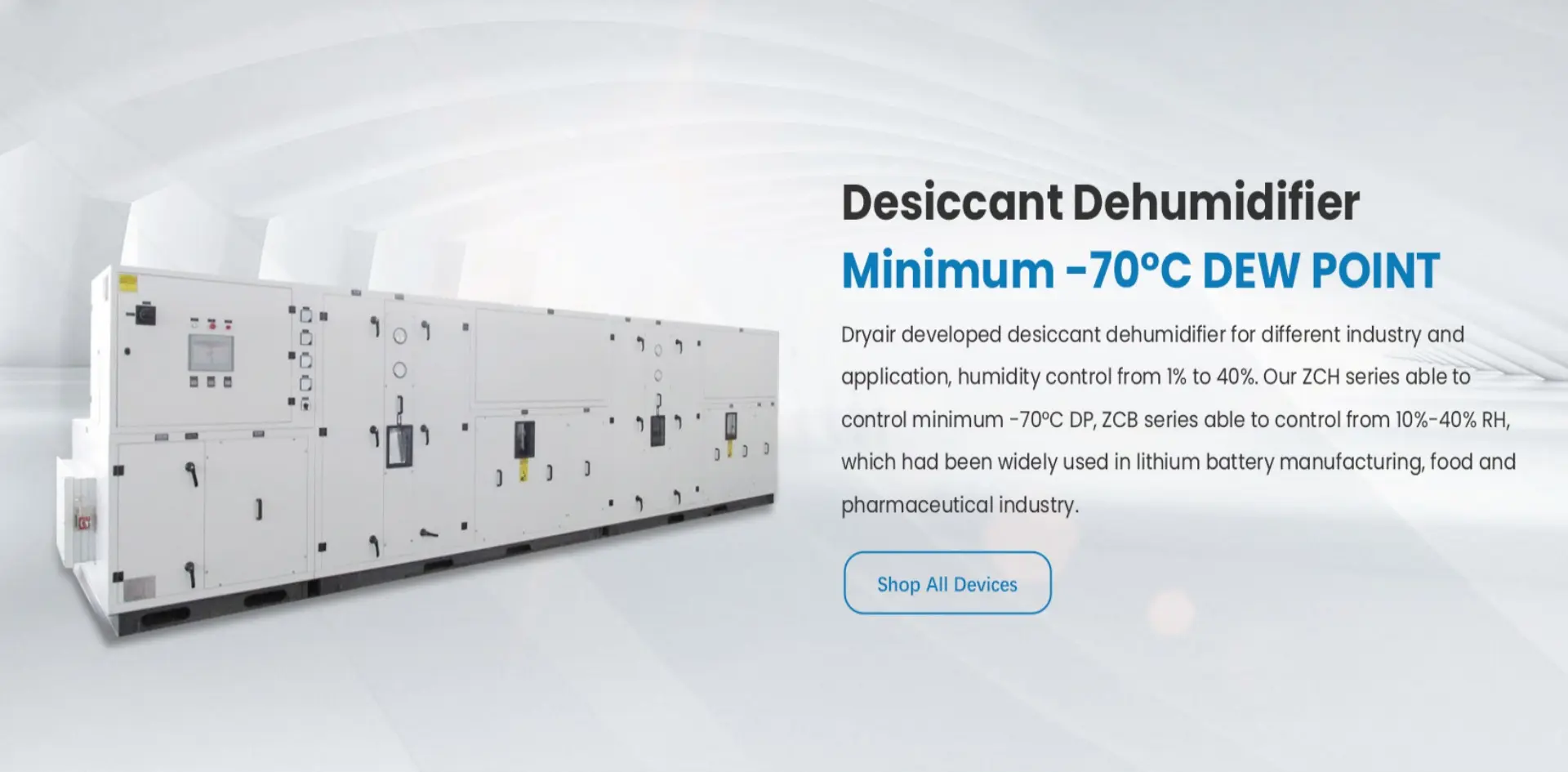 Sub-Zero Dew Point
Next-generation ultra-dry microclimates delivering continuous -65°C to -75°C dew points tailored for sulfide-based solid electrolyte research.
Next-Gen Dry Enclosures GJB Military Certified
Heavy-duty corrosion-resistant atmospheric humidity management designed to protect munitions, missile silos, and avionics storage depots.
Aerospace ValidationA rigorous engineering analysis of moisture kinetics, vapor phase adsorption, and cleanroom atmospheric stabilization for precision industrial manufacturing.
Industrial rotary desiccant dehumidification departs from traditional mechanical refrigeration when operating temperatures fall below the freezing plateau or when target moisture requirements plunge below a 5°C dew point. Conventional cooling coils inevitably suffer evaporator frosting, drastically decreasing the coefficient of performance (COP) and stalling mass transfer. In contrast, Hangzhou DryAir Treatment Co., Ltd. (DryAir) deploys a continuous adsorption wheel fabricated from high-density corrugated glass-fiber matrix chemically bonded with proprietary synthesized active silica gel or molecular sieve adsorbents.
The system operates along a dual-stream psychrometric cycle: the process air stream passes through the rotating sorption sectors (typically three-quarters of the wheel face area), where water molecules are captured in nano-capillary pores through van der Waals forces, releasing latent heat of adsorption. Simultaneously, an isolated, counter-flow reactivation air stream, preheated to between 120°C and 140°C via steam coils, electric heaters, or direct-fired gas burners, expels the trapped moisture from the remaining rotor quadrant, restoring the adsorbent matrix for continuous cyclic duty.
Capable of sustaining extreme industrial microclimates for next-gen lithium metal and solid-state cell assembly.
Dual-stage chilled condensation and regenerative purification eliminating toxic organic emissions.
Dominant market share within China's lithium gigafactory desiccant dehumidification infrastructure.
Standardized automated fabrication lines sustaining simultaneous multi-phase global factory turnouts.
How Hangzhou DryAir leverages upstream metallurgical integration, rotor synthesis, and high-speed assembly to slash CAPEX while accelerating lead times.
Unlike assemblers reliant on imported third-party wheels, our localized supply chain integrates synthetic silicates and structural ceramics directly, guaranteeing unmatched water retention capacity, high thermal shock resistance, and zero chemical wash-off during prolonged industrial campaigns.
Our Lin'an, Hangzhou industrial campus houses automated CNC laser punching, continuous robotic TIG welding, and electrostatic powder coating. Unit frames utilize thermal-bridge-free double-wall PU insulation (thermal transmittance Class T1, air leakage Class L1 under EN 1886 standard).
China's high-efficiency heat pump and plate heat exchanger supply chains are embedded within our base assemblies. We redirect sensible heat from refrigeration condensers and high-temperature waste air back to the desiccant reactivation zone, reducing gross operating electrical expenditure by up to 35%.
While European and North American manufacturers quote 32 to 48 weeks for custom heavy desiccant machinery, DryAir’s vertically clustered parts sourcing delivers fully verified, factory-accepted units within 10 to 14 weeks, keeping client gigafactory construction trajectories on track.
With an active monthly output exceeding 200 industrial-grade modular units, our manufacturing floor accommodates rapid expansion phases of tier-one cell developers without quality dilution, supported by 74 dedicated HVAC PhDs, senior thermodynamic engineers, and master craftsmen.
Clients capture up to a 40% reduction in total capital expenditure without sacrificing engineering integrity. Every unit is fitted with top-tier international components (Siemens PLCs, Schneider switchgear, ABB inverters) while retaining the cost efficiencies of domestic advanced fabrication.
A rigorous inspection matrix outlining technical parameters, life-cycle costs, psychrometric performance SLAs, and field-readiness standards.
Global procurement teams navigating high-risk battery gigafactory tenders, pharmaceutical compounding plants, and aerospace test cells adhere to strict auditing matrices. A failure in dry room containment or a dew point drift from -50°C to -30°C can result in millions of dollars of scrap electrolyte and ruined cathodes within hours. The following criteria represent mandatory engineering thresholds evaluated during international vendor qualification:
| Evaluation Parameter | Standard Industry Baseline | DryAir Engineering Standard | Operational Impact & Gain |
|---|---|---|---|
| Supply Air Dew Point Limit | -40°C to -50°C DP | -70°C Controllable Dew Point | Prevents lithium cell micro-swelling and enables sulfide solid-state processing. |
| AHU Casing Air Leakage Rate | EN 1886 Class L2 (≤ 0.44 L/s·m²) | EN 1886 Class L1 (≤ 0.15 L/s·m²) | Mitigates parasitic external moisture ingress under continuous negative pressure. |
| NMP Recovery Efficiency | 90% – 95% Solvent Capture | ≥ 99% Mass Recovery Rate | Dramatically reduces recurring NMP purchases while satisfying strict EU/EPA limits. |
| Rotor Operational Lifespan | 3 – 5 Years (Standard Silica) | 8 – 10 Years Continuous Duty | Inorganic synthetic binder preserves capillary micro-structures against thermal fatigue. |
| Regeneration Thermal Strategy | Direct High-KW Electric Heating | Hybrid Steam / Gas / Waste Heat | Decreases whole-facility utility demand by 28% to 35%, boosting long-term plant OPEX. |
| Cleanroom Particulate Filtration | F7 / F9 Bag Filters Only | G4 + F8 + H13 / H14 Terminal HEPA | Complies with ISO 14644-1 Class 5 cleanliness standards for microelectronics. |
Specific field deployment configurations across ultra-clean lithium manufacturing, API production, military depots, and petrochemical recovery.
Exposure of hexafluorophosphate (LiPF6) electrolyte to ambient humidity generates corrosive hydrofluoric acid (HF), causing cell venting and fatal loss of capacity. DryAir turnkey dry rooms maintain supply air between -50°C and -70°C dew point across the winding, assembly, and filling zones under tight positive pressure profiles.
Powder compression, effervescent tableting, and gelatin capsule encasement demand stable relative humidity below 20% RH at 22°C. Excessive moisture causes powder clumping, tableting die seizure, and enzymatic degradation. Our systems deliver laminar low-RH airflow sanitized by terminal H14 HEPA filtration banks.
Engineered under the National Military Standard (GJB9001C), DryAir preservation systems safeguard propellant energetics, radar avionics, missile casings, and aircraft airframes from electrochemical galvanic corrosion and mold formation in extreme coastal or subtropical climates.
Electrode slurry drying evaporates vast volumes of N-Methyl-2-pyrrolidone. Our closed-loop ZJRH plant captures volatilized solvent vapors via multi-stage cold trap condensation followed by zeolite rotary concentration, returning reusable pure liquid solvent and cutting plant emissions to well under 5 mg/Nm³.
Wafer track equipment and lithographic optical exposure chambers require humidity control within ±0.5% RH and stringent elimination of airborne molecular contaminants (AMCs). DryAir pairs catalytic filtration stages with ultra-low dew point runners to prevent micro-condensation on wafer surfaces.
Offshore nacelles and marine substations operate in harsh 95%+ RH environments laden with saline aerosols. Our compact, marine-varnished desiccant air handlers maintain nacelle internals below 40% RH, permanently arresting switchgear flashover and mechanical bearing pitting.
Seamless qualification across Europe, the Americas, and Asia with exhaustive third-party engineering certifications and lifecycle service agreements.
Fully compliant with EU Machinery Directive 2006/42/EC, Low Voltage Directive, and UL 1995/CSA standards for North American industrial grid hookup.
Heat exchangers, condenser shells, and high-pressure steam coils are stamped in accordance with ASME Boiler and Pressure Vessel Code and EU PED directives.
Certified for the Eurasian Customs Union (TR CU 010, 004, 020) alongside certified compliance with China's GJB9001C national defense quality management system.
Optional 24-month comprehensive overseas maintenance agreement, including remote SCADA tele-diagnostics, rapid spare parts deployment, and on-site engineering crews.
Overcoming cross-border execution hurdles is the hallmark of DryAir’s overseas engineering delivery. Every export installation undergoes full Factory Acceptance Testing (FAT) in our simulated psychrometric chamber in Lin’an, where target temperature, humidity, and airflow rates are validated before crating. On arrival, our field deployment squads handle on-site assembly, duct pressure testing, and Site Acceptance Testing (SAT) alongside local EPCs in the US, Sweden, Germany, Poland, Hungary, Vietnam, and India.
A closed-loop 5-phase execution model eliminating jurisdictional gray areas between equipment manufacturers, cleanroom builders, and facility managers.
Dynamic latent moisture calculation incorporating personnel sweat rates, door openings, envelope transmission, and process exhaust requirements.
CFD modeling of supply laminar velocity, ceiling distribution diffusers, return risers, and stagnant microclimate elimination within equipment enclosures.
Structural frame assembly, thermal-barrier panel foaming, rotor mounting, dynamic wheel balancing, and continuous testing in our psychrometric lab.
Laser alignment, duct pressure containment decay tests, helium leak searches, air balancing, and dew point stabilization logging.
IoT cloud-linked psychrometric telemetry, scheduled desiccant wheel surface washes, filter degradation tracking, and predictive maintenance dispatch.
Anticipating the technological disruptions shaping solid-state batteries, decarbonized thermal regeneration, and smart automated environmental controls.
As EV battery chemistry shifts from liquid electrolytes to sulfide-based solid-state architectures (such as Li10GeP2S12), the generation of toxic hydrogen sulfide (H2S) gas in contact with trace moisture requires ultra-dry limits shifting from -50°C to -80°C DP. DryAir is developing multi-stage cascade molecular rotors to sustain this critical threshold continuously.
In adherence to the Kigali Amendment and EU F-Gas phase-downs, DryAir is retrofitting pre-cooling and condensation stages with next-generation refrigerants, including R290 (propane) and transcritical CO2 (R744) circuits, achieving superior volumetric efficiency while nullifying global warming impacts.
Traditional constant-volume regeneration wastes significant energy during dry winter periods. DryAir's adaptive AI neuro-controller dynamically correlates outdoor ambient humidity data, real-time indoor latent worker density, and wheel exhaust enthalpy to modulate heater power, cutting annual energy consumption by up to 22%.
In-depth, unambiguous engineering answers regarding psychrometric performance, factory auditing, field validation, and overseas support.
Directly access specifications, airflow capacities, psychrometric performance curves, and project references across our complete production catalog.
Custom Engineered
Integrated air purifier and dehumidification units equipped with high-torque gear drives and dual isolation seals.
Download DHU Datasheet
Complete Facility EPC
Air-tight modular cleanrooms designed for gigawatt-scale production lines, backed by verified dew point containment.
Turnkey Project Specs
Solvent Reclamation
Advanced NMP recovery trains delivering continuous closed-loop condensation with emissions verified below strict EU thresholds.
Calculate Solvent ROI
VOC Elimination
Regenerative thermal oxidizers combined with pre-treatment condensation chillers to safely treat concentrated process exhaust.
Inspect Emission Systems
High COP Air Handling
High-efficiency mechanical condensation dehumidifiers engineered for pre-cooling intake air in massive pharmaceutical spaces.
Explore Chiller Lines
GMP Certified
Sanitary double-skin air handlers fitted with continuous UV-C germicidal irradiation and terminal HEPA filters for sterile filling rooms.
Request Pharma Specs
R&D Pilot Lines
Scalable, quickly deployable dry room modules engineered for advanced battery R&D centers, universities, and pilot manufacturing.
Configure Modular Room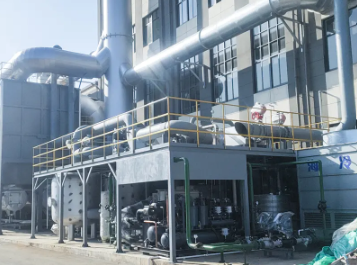 Petrochemical Grade
Heavy-duty condensation systems that capture fugitive hydrocarbon vapors during fuel terminal loading, storage, and transfer operations.
Review Petro Systems