
 -70°C Dew Point
Desiccant Dehumidifier (DHU Series)
Heavy-duty rotary desiccant wheel engineered for ultra-low humidity environments with proprietary heat-recovery regeneration matrices.
View SpecificationsEngineered for extreme dew point stability, volatile solvent condensation, and mission-critical enclosure micro-climates. Explore our factory-direct machinery portfolio.
-70°C Dew Point
Heavy-duty rotary desiccant wheel engineered for ultra-low humidity environments with proprietary heat-recovery regeneration matrices.
View Specifications Turnkey EPC
Complete modular sealed envelope engineering, hermetic ductwork, low-leakage interlocks, and PLC closed-loop control.
Explore Dry Rooms ≥99% Recovery
Recycles N-Methyl-2-pyrrolidone solvent from electrode coater lines, reducing emissions and operating costs significantly.
Inspect Recovery Unit Cooling + RTO
Deep cryogenic condensation combined with regenerative thermal oxidizers (RTO) for chemical gas destruction.
Explore VOC Systems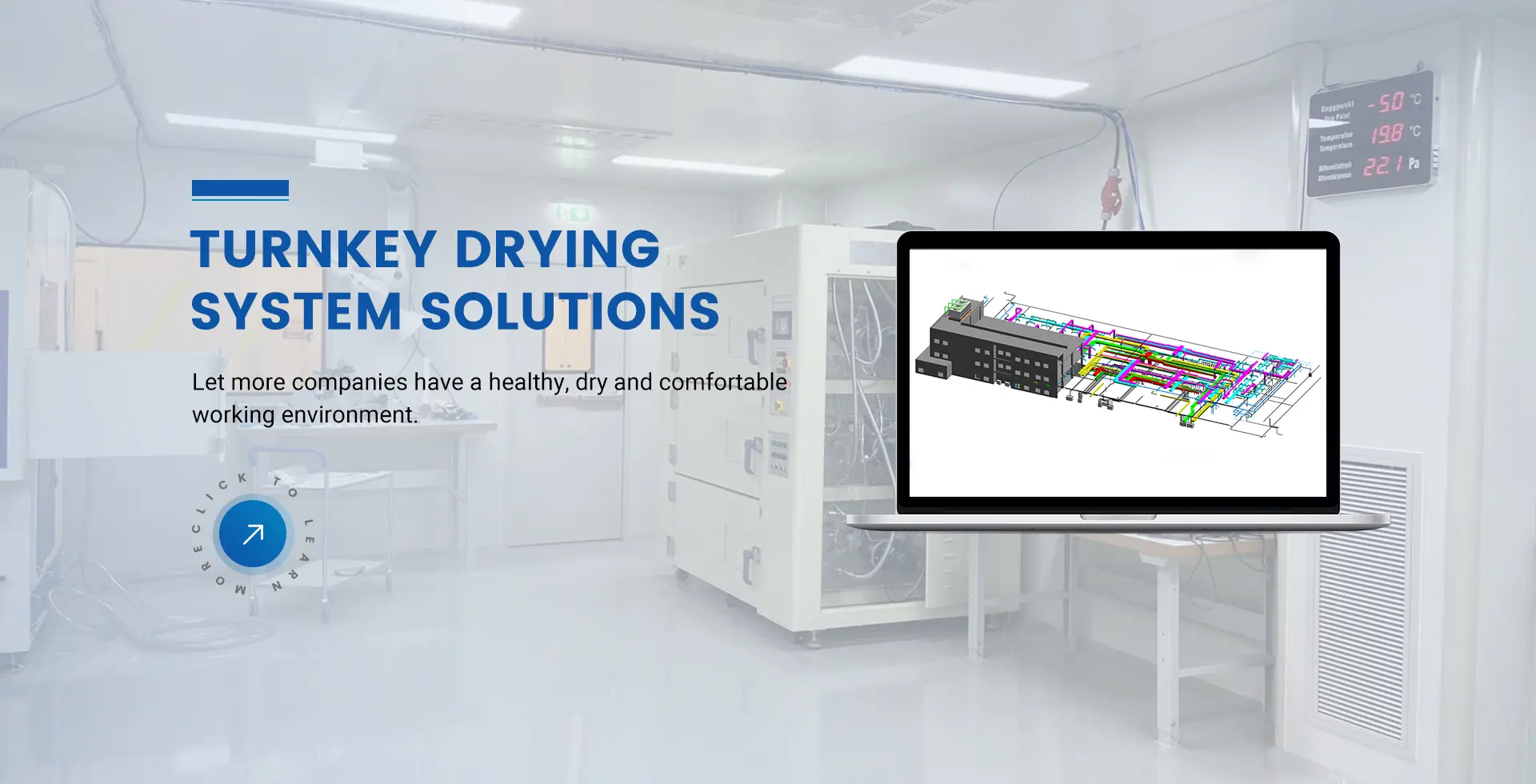 Pre-Cooling Stage
Commercial and industrial condensing systems suited for high-latent-load warehouse conditions and pre-desiccant stages.
View Chilling Units Smart Cabinet IoT
Intelligent micro-environment dehumidification for electrical switchgear, telecom racks, battery modules, and storage chambers.
Cabinet Systems GJB Compliant
Engineered to national military specifications (GJB) to eliminate corrosion risks across radar, ordnance, and avionics storage.
Technical Data Engineering Spec
Complete schematics, airflow capacity calculators, regeneration steam/electric curves, and dimensional CAD blue-prints.
Download CatalogHow decentralized micro-environment moisture extraction is superseding legacy HVAC architectures across global industrial infrastructure.
Traditional industrial facilities historically conditioned entire warehouse spaces at immense energy costs. Contemporary high-tech manufacturing—spanning advanced lithium-ion cells, semiconductor wafers, and smart electric switchgear—relies on modular micro-climates. China smart cabinet dehumidifier factories produce self-contained, hermetically monitored drying units that directly protect critical enclosure envelopes down to 10% RH or -70°C dew point without conditioning massive ambient volumes.
With miniaturized photolithography and wafer transfer FOUPs requiring strict environmental stability, smart cabinet dehumidifiers eliminate micro-condensation hazards. Solid-state thermoelectric Peltier modules and compact rotor cassettes prevent electrostatic discharge and dielectric breakdown, driving double-digit compound annual growth rates across East Asia, North America, and Western Europe.
Industrial HVAC accounts for up to 43% of total thermal and electrical consumption in battery gigafactories. Deploying decentralized smart cabinet dehumidifiers directly on localized staging lines, automated storage and retrieval systems (ASRS), and power distribution switchboards curtails continuous regeneration power draw, aligning tier-one industrial producers with Net-Zero compliance frameworks.
Industrial Engineering Insight: When moisture infiltrates electrical switchgear or battery storage cabinets, dielectric insulation degrades exponentially. A relative humidity shift from 45% to 75% RH can lower insulation resistance across medium-voltage busbars by up to 88%, causing flashovers, catastrophic arcing, and unbudgeted plant shutdowns. Chinese manufacturing clusters led by Hangzhou DryAir have established automated semiconductor-grade sensing arrays that trigger micro-drainage cycles in sub-second intervals.
Established in 2010 in Lin'an Qingshan Industrial Park, Hangzhou DryAir Treatment Co., Ltd. commands over 30% of China's industrial desiccant dehumidification landscape.
Hangzhou DryAir operates under both international ISO 9001 quality frameworks and China's stringent GJB national military manufacturing standard. Every smart cabinet dehumidifier and industrial rotor undergoes end-to-end helium mass spectrometer leak detection and psychrometric validation before dispatch.
Our desiccant dehumidifiers, NMP recovery systems, and smart cabinet enclosures are operating round-the-clock inside facilities run by Tesla, Northvolt, CATL, ATL, BYD, EVE Energy, Farasis, Envision, SVOLT, and TTI. We understand high-throughput gigafactory failure modes and engineer them out at the schematic stage.
Engineered for seamless international compliance, DryAir machines ship fully certified to CE (Machinery & Low Voltage Directives), UL (Underwriters Laboratories, USA), CSA (Canadian Standards Association), ASME pressure vessel stamping, and EAC technical regulations for Eurasian economic territories.
Comparing the thermodynamic efficiency of smart solid-state Peltier condensation versus continuous rotary desiccant sorption across industrial enclosures.
| System Architecture | Core Mechanism | Achievable Dew Point / RH | Energy Efficiency (COP) | Ideal Application Profile |
|---|---|---|---|---|
| Solid-State Semiconductor Cabinet Dehumidifier | Peltier-effect cold-junction condensation with rapid capillary drainage | Down to 20% RH (+2°C to +5°C DP) | High COP at localized small footprint (<2.5 m³) | Outdoor 5G telecom cabinets, distribution transformer boxes, ring main units (RMU). |
| Micro-Rotary Desiccant Cabinet Dehumidifier | Molecular sieve / silica gel synthesized honeycomb wheel with continuous PTC regeneration | Ultra-Dry Down to -40°C ~ -70°C DP | Optimized through waste-heat matrix recycling | Lithium battery cell formation, solid-state battery R&D gloveboxes, laser welding chambers. |
| Hybrid Membrane / Desiccant Enclosure System | Selective hollow-fiber moisture separation coupled with desiccant drying | -30°C to -50°C DP | Continuous duty without refrigeration compressor | Hermetic automated warehouse storage (ASRS), semiconductor wafer pod loading locks. |
| Centralized Macro Turnkey Dry Room System | Dual-rotor cascading desiccant dehumidification with deep glycol chilling | Sustained -70°C DP Process Supply | Maximized for multi-operator gigafactory halls | Commercial pouch/prismatic cell electrolyte filling lines, cathode/anode assembly suites. |
Hangzhou DryAir is actively commercializing synthetic MOF rotor materials. These crystal lattices feature exceptionally high surface areas, dropping the thermal regeneration temperature requirement from traditional 130°C down to 75°C. This breakthrough permits battery cabinet drying using low-grade waste steam from cathode baking ovens.
Our latest smart cabinet series integrates edge-computing microcontrollers communicating via Modbus TCP/IP, MQTT, and BACnet. Proprietary algorithms model external ambient barometric pressure, localized temperature shifts, and door-opening frequency to predictively spool regeneration fans prior to dew-point spikes.
Even fractional ingress of moisture can spoil a dry cabinet batch. DryAir incorporates continuous silicone bubble gasketing, laser-welded stainless 304/316 chassis walls, and magnetically coupled blowers that eliminate traditional shaft-seal leakage routes entirely.
From Nordic sub-zero battery corridors to humid tropical marine substations, Hangzhou DryAir systems are customized for distinct micro-environments.
During electrolyte filling and jelly-roll assembly, exposure to moisture forms hydrofluoric acid (HF), causing irreversible cell swelling, capacity degradation, and fire risk. Hangzhou DryAir delivers localized dry cabinets maintaining -40°C to -70°C dew point air curtains, safeguarding cells immediately prior to laser hermetic sealing.
Hygroscopic active pharmaceutical ingredients (APIs), effervescent formulations, and softgel capsule drying demand exact relative humidity between 10% and 25% RH. Our smart cabinet dehumidifiers prevent powder agglomeration on high-speed rotary presses, maintaining strict FDA and GMP cleanliness guidelines.
Outdoor gas-insulated switchgear (GIS) cabinets and offshore wind turbine nacelles face severe diurnal temperature swings. Uncontrolled condensation causes electrical tracking and short circuits. Our solid-state intelligent cabinet dehumidifiers automatically extract moisture and expel condensation droplets outside the enclosure shell.
Built according to GJB military criteria, our defense storage dehumidifiers safeguard missile guidance sensors, optical night-vision apparatus, and propellant charges. Sustaining storage chambers at ≤35% RH eliminates electrochemical oxidation and shelf-life degradation indefinitely.
Coating processes generate intense VOC and N-Methyl-2-pyrrolidone vapors. DryAir's multi-tier condensation scrubbers and zeolite rotor wheel concentrators trap solvent molecules with ≥99% recovery efficiency, preventing toxic emissions and yielding purified solvent for industrial re-circulation.
How real-time telemetry, digital twin monitoring, and predictive PID control loops optimize operational reliability and lifecycle costs.
Each intelligent cabinet module incorporates dual thin-film capacitive sensors and optical chilled-mirror dew point instruments. Cross-verification logic flags drift instantly, safeguarding against sensor fouling in chemical-laden or high-dust factory zones.
DryAir units come equipped with Ethernet and RS485 communication protocols. Factory automation supervisors can aggregate hundreds of decentralized cabinet dehumidifiers into one master SCADA screen, tracking kWh per gram of extracted water and generating automated audit reports.
By correlating rotor rotational friction, motor current draw, and differential pressure across the process filter, the onboard smart controller predicts drive-belt fatigue and particulate saturation weeks before mechanical compromise occurs, preventing production stops.
From psychrometric balance calculations to international on-site validation, Hangzhou DryAir retains total operational accountability.
Comprehensive process audit mapping moisture infiltration rates, door cycling frequencies, personnel latent respiration loads, and product hygroscopic moisture content.
CFD airflow simulation, regeneration energy modeling, structural thermal-break design, and precise desiccant rotor diameter/speed calculations.
CNC sheet metal cutting, automatic laser welding, rotor cassette mounting, and full factory performance verification inside DryAir's in-house test rooms.
Deployment by certified DryAir HVAC engineers to install, level, duct, wire, purge, and commission cabinet and room dehumidification systems.
Continuous remote diagnostic link, regional spare parts warehouses, emergency dispatch, and optional two-year overseas extended maintenance agreements.
In-depth technical answers addressing dew point thresholds, international exports, power regeneration, and turnkey warranties.
Contact Hangzhou DryAir engineers to request psychrometric load designs, factory price quotes, and CAD layouts for your target system.
Deep Dew Point
Precision rotary moisture extraction systems for battery dry rooms, military munitions, and low-humidity storage.
View Product RFQ
Turnkey EPC
Complete environmental design, modular wall assemblies, cascading airlocks, and validation to -70°C dew point.
Review Dry Room Specs
Solvent Capture
Recovers valuable N-Methyl-2-pyrrolidone solvent from coating exhaust, lowering plant emissions and OPEX.
NMP Unit Details
Clean Emissions
Cryogenic condensation and regenerative thermal oxidizers to treat industrial emissions and oil vapors cleanly.
View VOC Catalogs
High Efficiency
Energy-efficient condensing dehumidifier series for standard manufacturing floors, clean storage, and pre-cooling.
View Refrigeration Units
IoT Micro-Climate
Compact automated dehumidification system for power distribution boxes, outdoor telecommunications, and battery racks.
Cabinet Catalog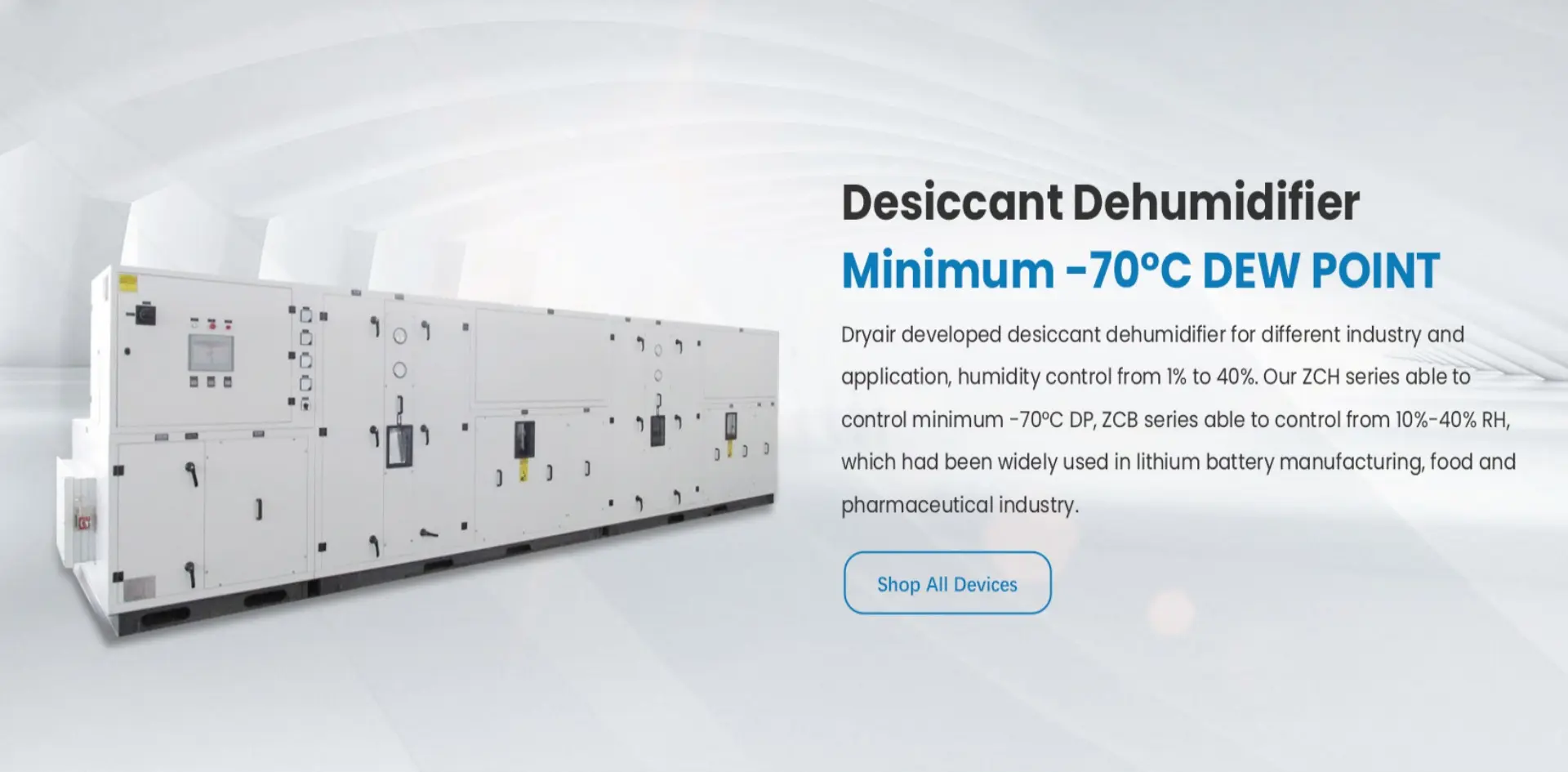 Worldwide EPC
On-site technical support, commissioning, emergency parts fulfillment, and comprehensive multi-year service contracts.
Overseas Service Hub
Technical Specs
Request detailed CAD blueprints, psychrometric performance graphs, utility hook-up schedules, and reference cases.
Request Full Catalog